What if your CRM could generate leads, all by itself?
It finds the owners, reads the situation, works out the repairs, the ARV and your maximum offer, and identifies the buyers most likely to want the deal —
Month to month · no contract · you approve every message before it sends
01 · Market huntsOwners you've never metSweeps your territory nightly for situations you told it to look for.
02 · WatchlistLeads already in your CRMRe-checks every record for the change that makes it worth a call.
03 · Zombie ProtocolLeads everyone else wrote offAnything untouched for 30+ days gets worked again, then left alone.
04 · Ghost ProtocolWebsite visitors who never filled out a formIdentifies recoverable visitors when enough first-party and identity data exists, and brings those opportunities back into view.
What it is
A lead generation system that never stops working.
Deal Radar is an active lead-generation and opportunity-monitoring system that continuously searches your market for real estate opportunities, while simultaneously watching the leads already inside your CRM for changes that could make them worth pursuing again.
These are the things it does — running whether you're logged in or not.
See it work
One deal, from setup to the check.
The actual software, in the order it happens. Click through at your own pace, or scroll on whenever you have seen enough.
Step 1 of 8 · you set it up
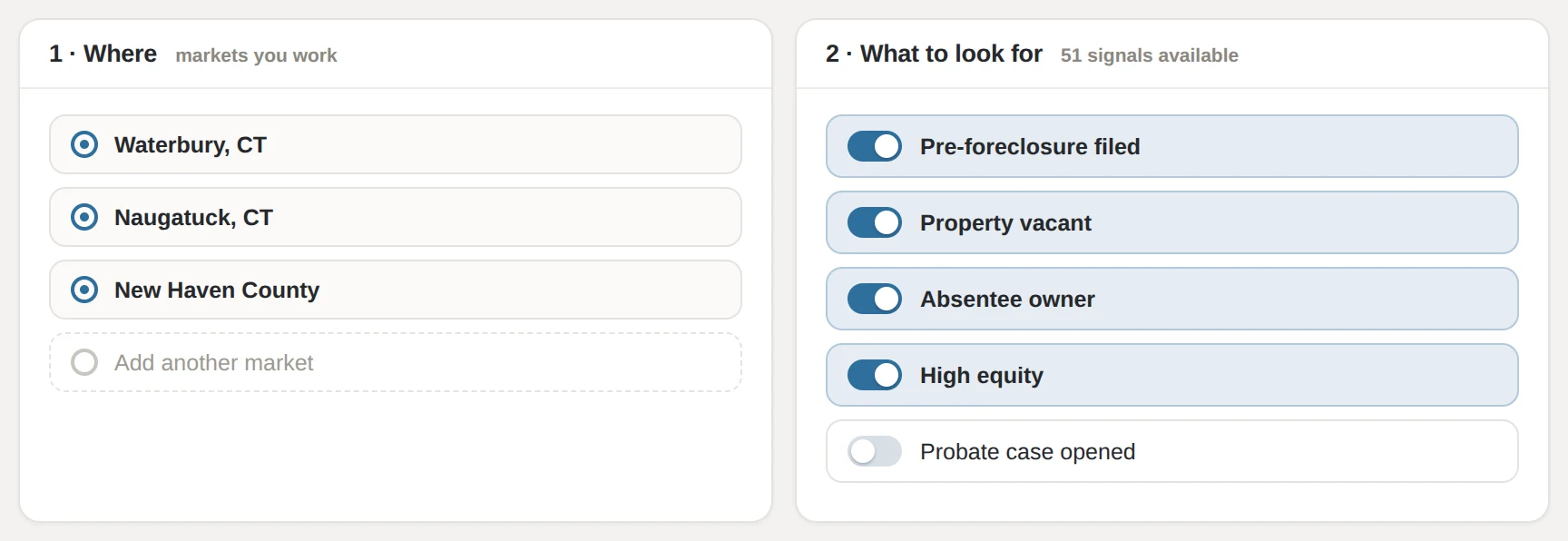
You tell it where you invest and what to look for.
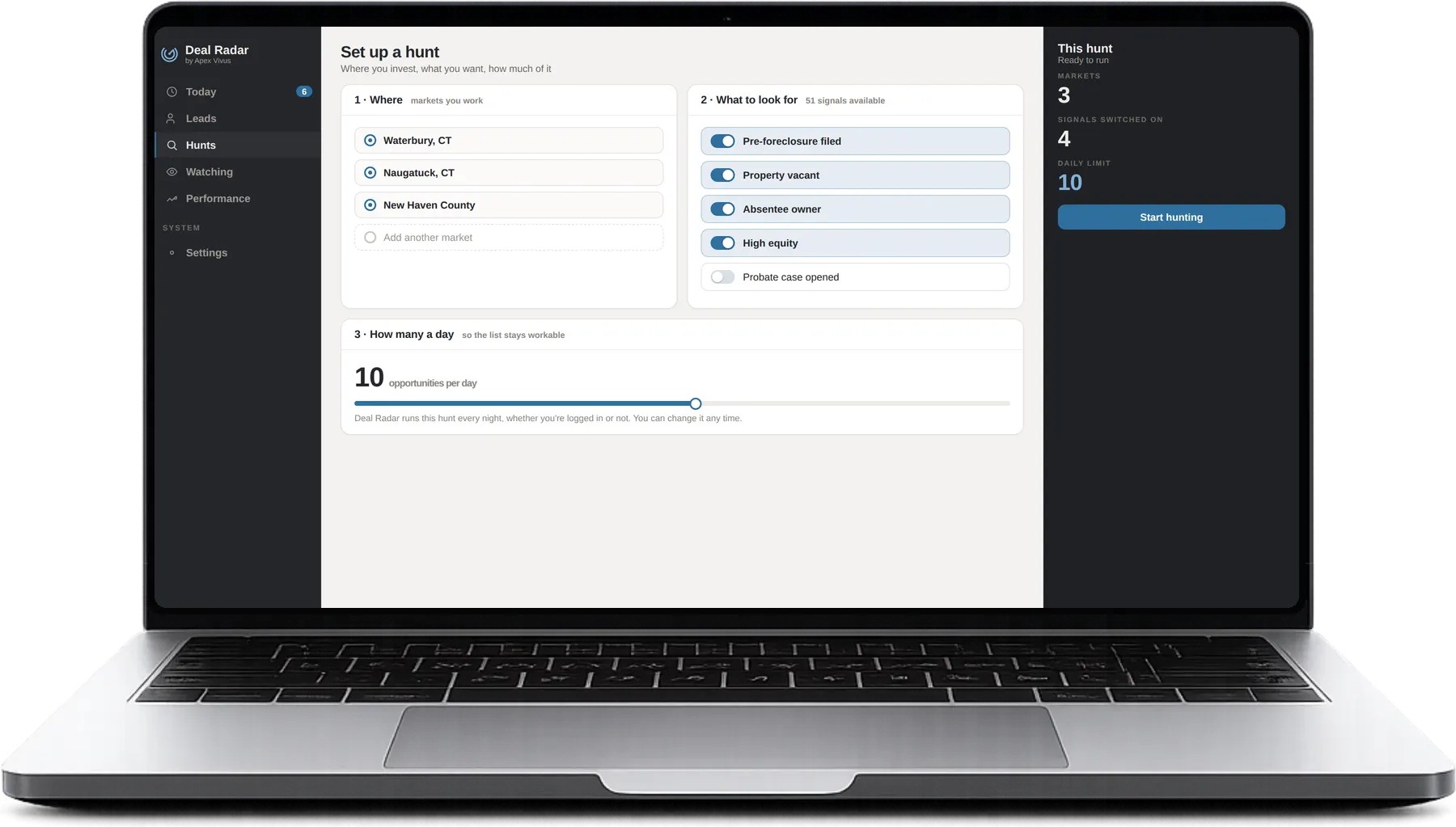
Pick your markets, switch on the situations you want — pre-foreclosure, vacant, absentee owner, high equity — and say how many opportunities a day you can actually work. That's the whole setup. From then on it runs every night whether you're logged in or not.
Step 2 of 8 · the next morning
It went looking while you slept.
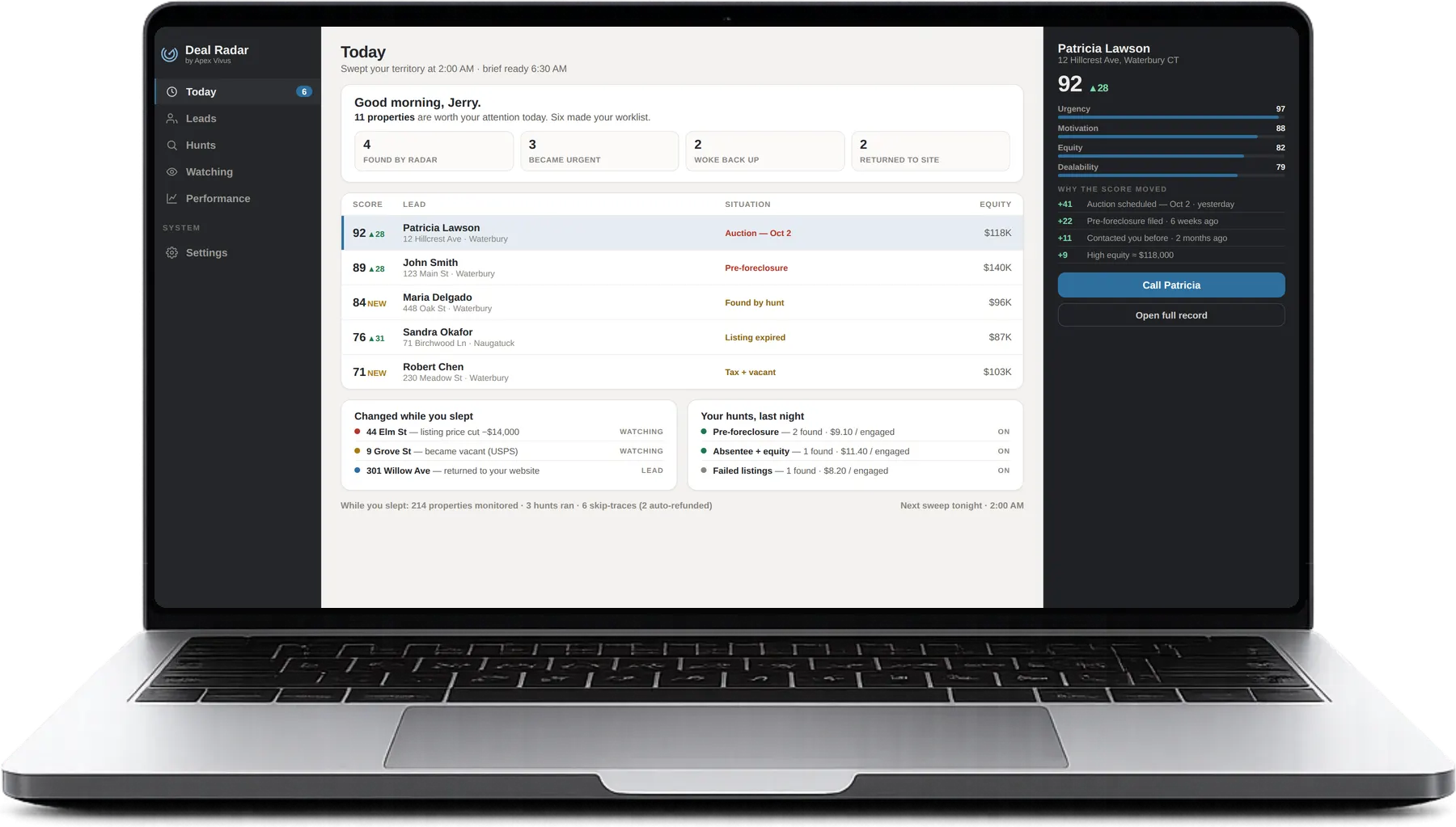
Eleven properties are worth your attention. Four are owners it found in your markets who have never heard of you. Three are leads you already had, where something changed. Two old ones came back to life. Two were on your website last night. You searched for none of it.
Step 3 of 8 · one it found
It found the owner, and everything about her situation.
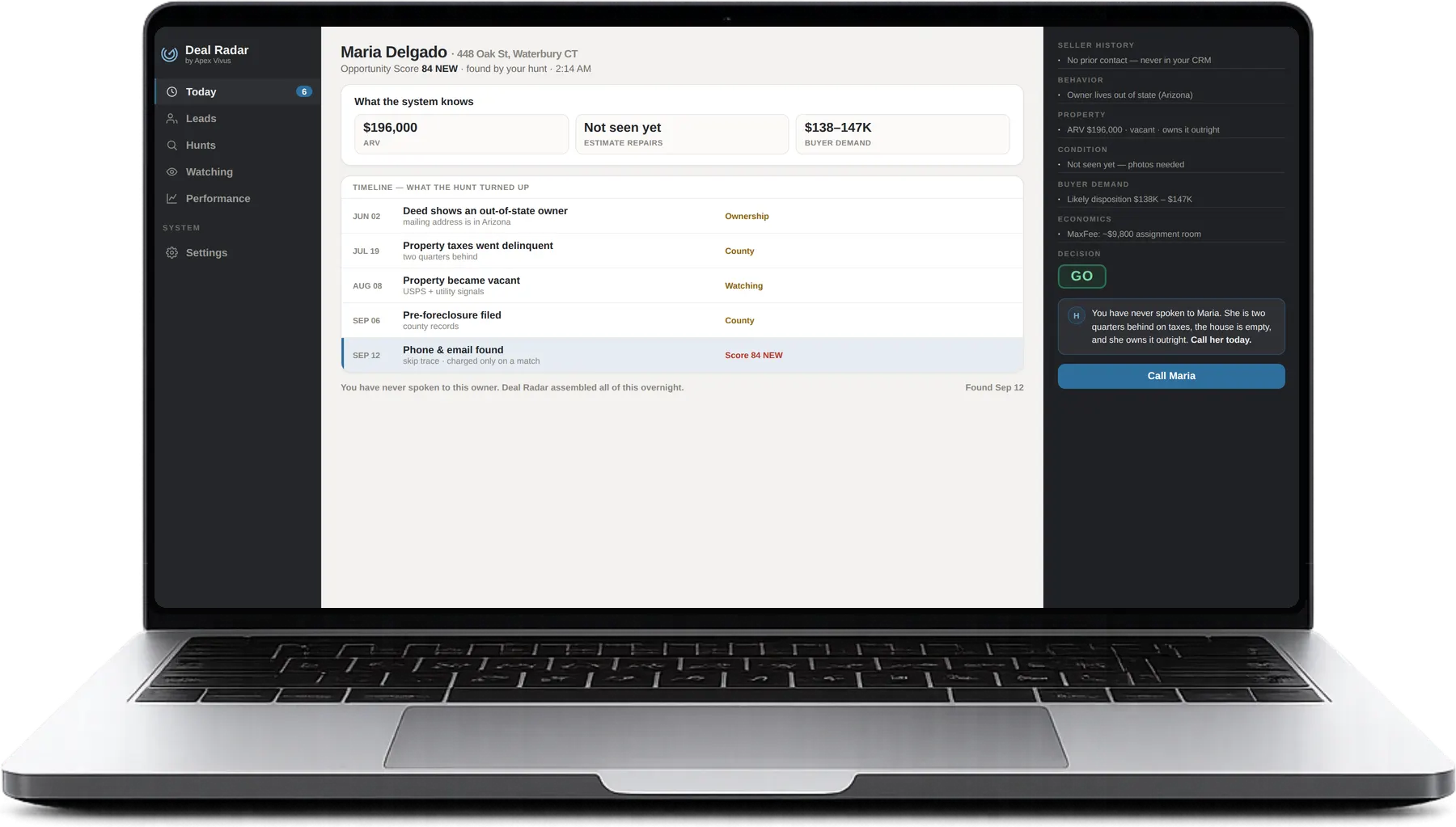
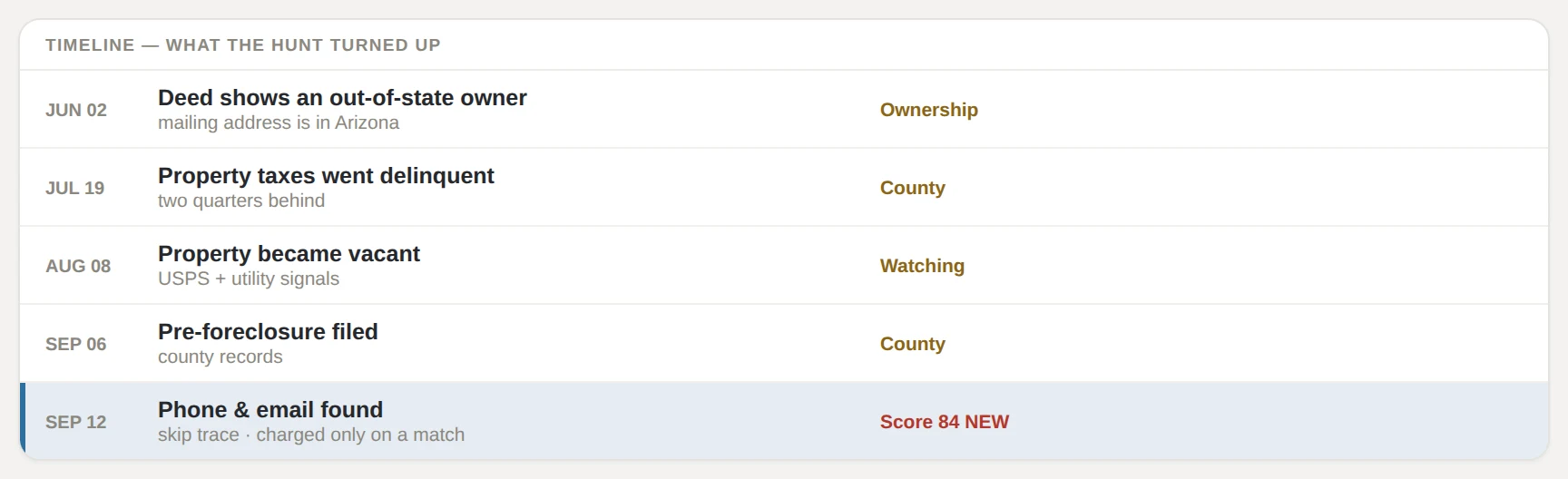
Maria Delgado, 448 Oak St. Not in your CRM, never filled in your website. Deal Radar found the property, worked out who owns it, and pulled her phone number and email. She lives in Arizona, she's two quarters behind on the taxes, the house has been empty since August, she owns it outright — and the auction is set for October 2.
Step 4 of 8 · it opens the conversation
Then it writes to her about the thing that's actually happening.
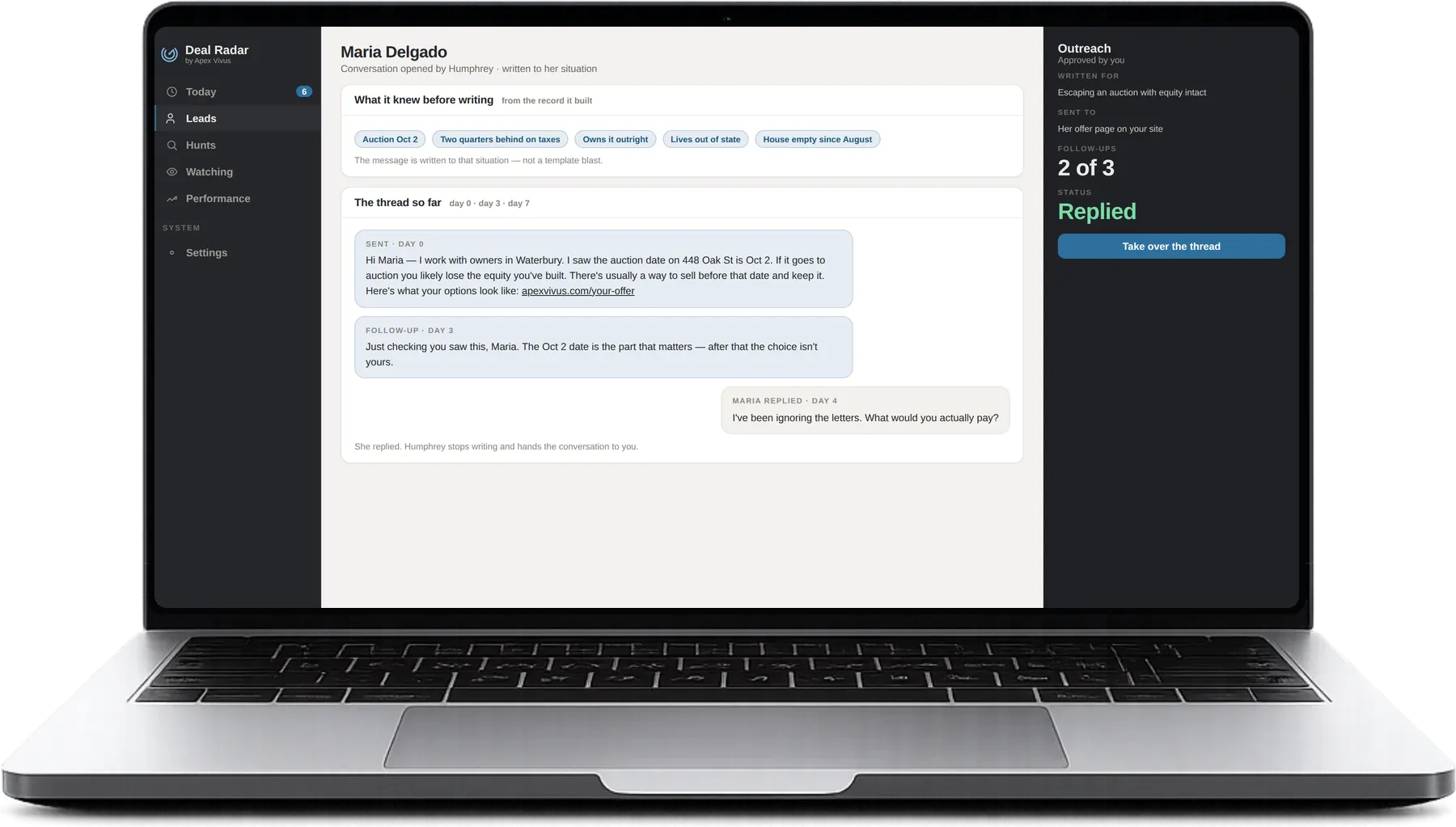
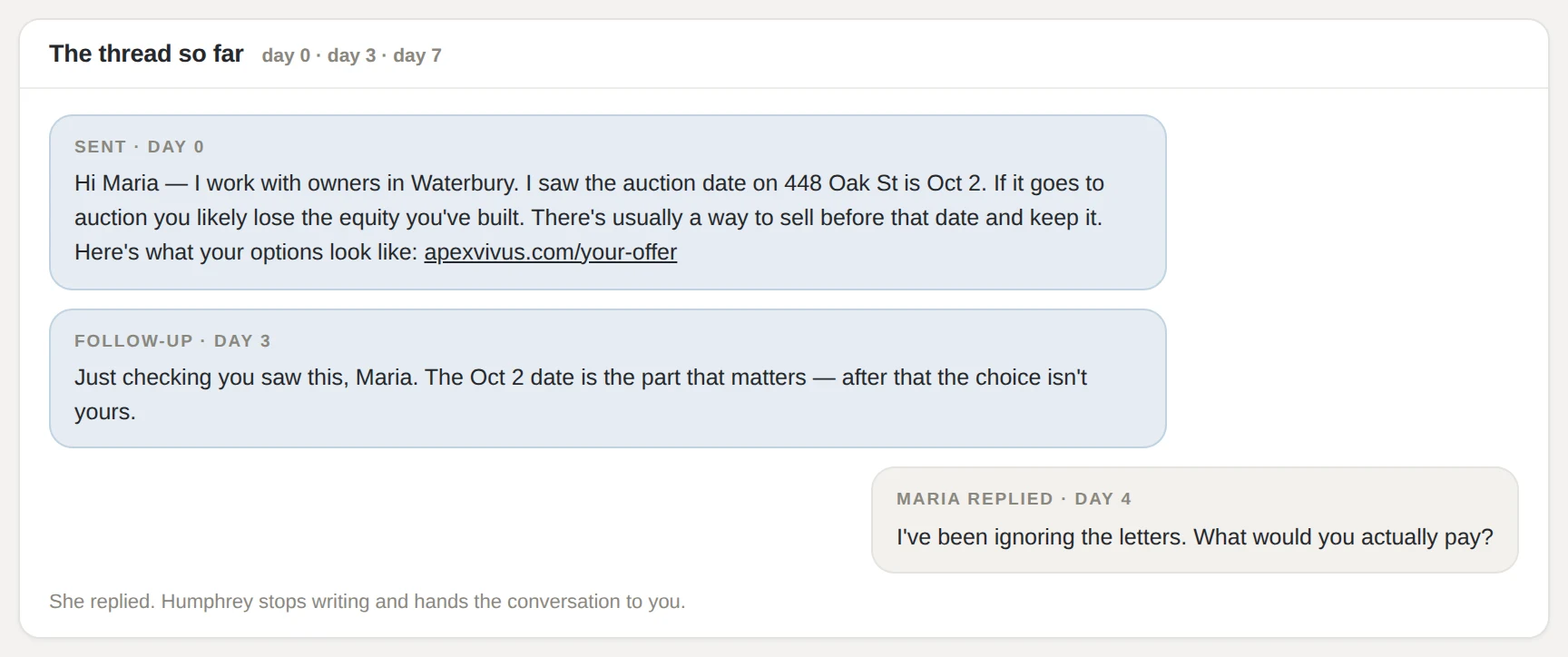
Not a template blast. Because it knows the auction date, the tax arrears and the equity, it drafts a message around what is actually happening — getting out from under the auction with her equity intact — and points her to the offer page on your website. You approve what goes out. Once approved, Deal Radar schedules the follow-up sequence and stops it automatically when she replies.
Step 5 of 8 · the ones you gave up on
Meanwhile it never stopped watching the people who said no.
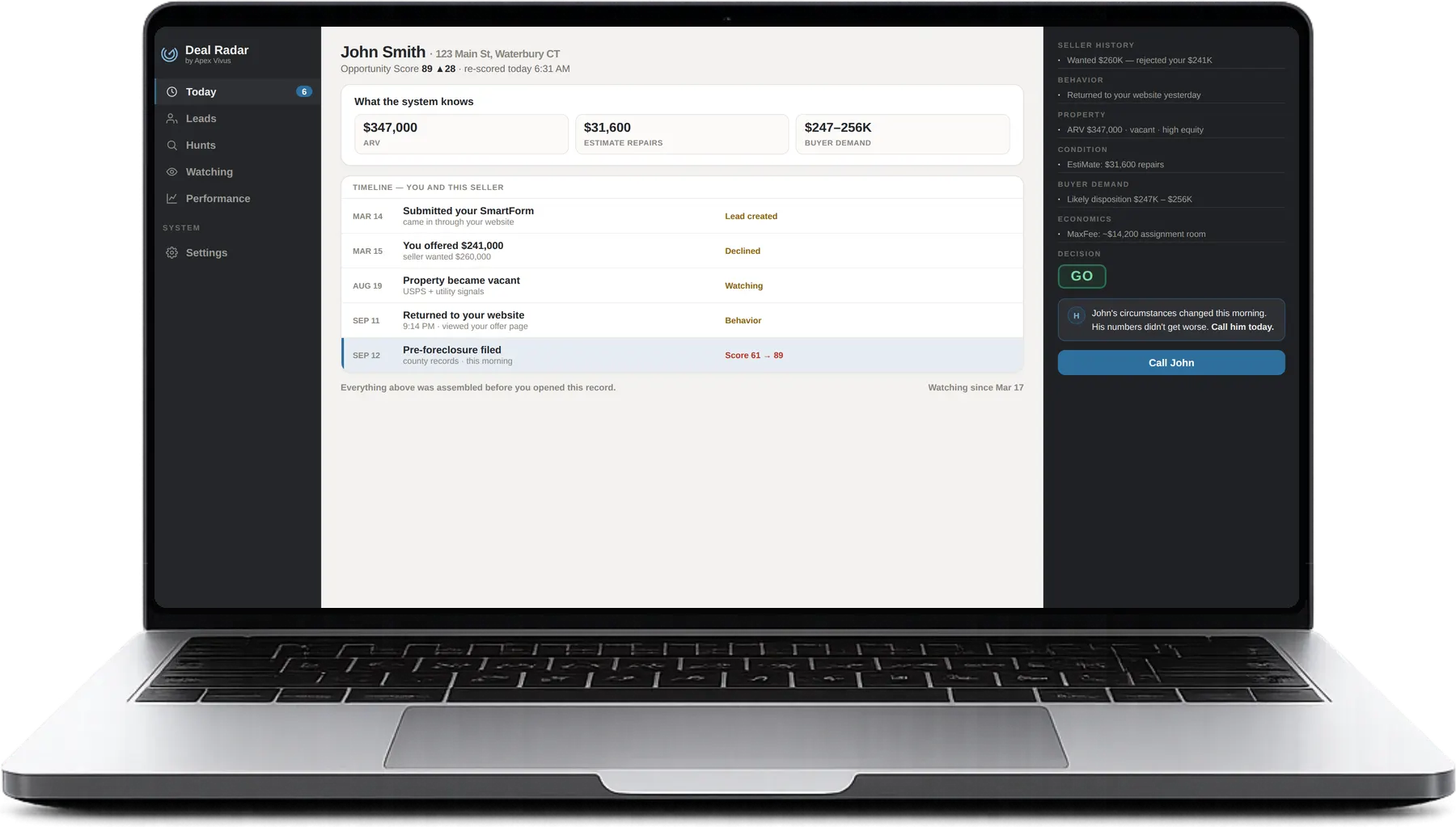
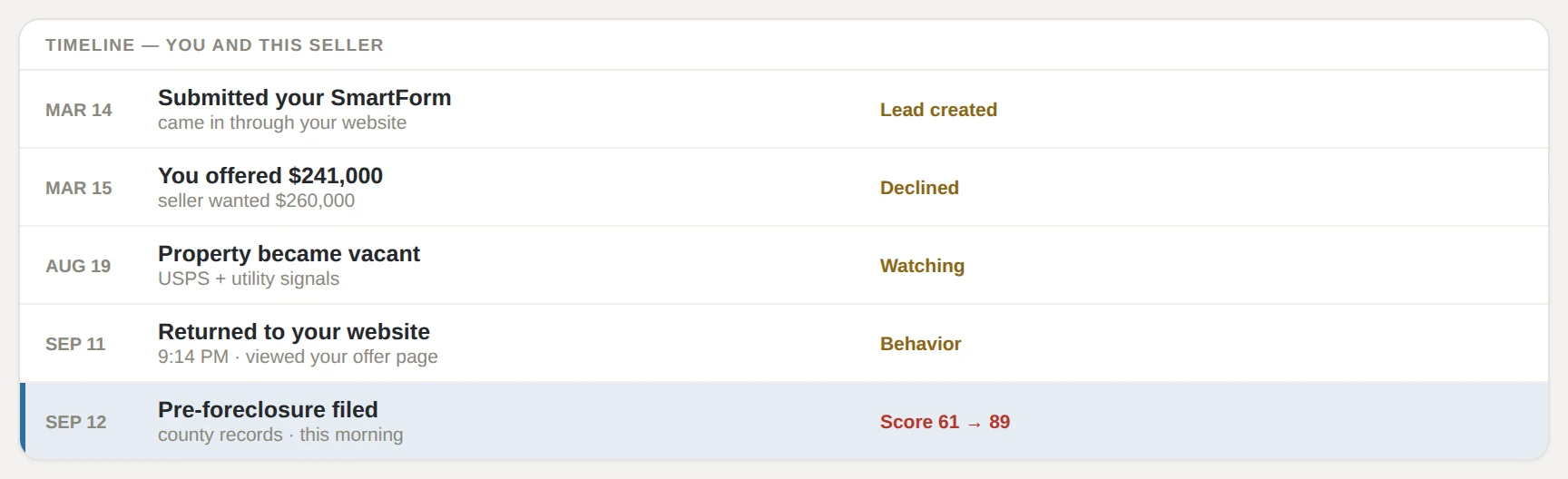
John Smith turned you down four months ago. You offered $241,000; he wanted $260,000. Deal Radar kept watching the house anyway. Last night he was back on your website; this morning the county filed a pre-foreclosure. His score moved 61 → 89 while you slept, and he's on today's list with the whole history attached.
Step 6 of 8 · the numbers
You ask for photos. The repair estimate runs itself.
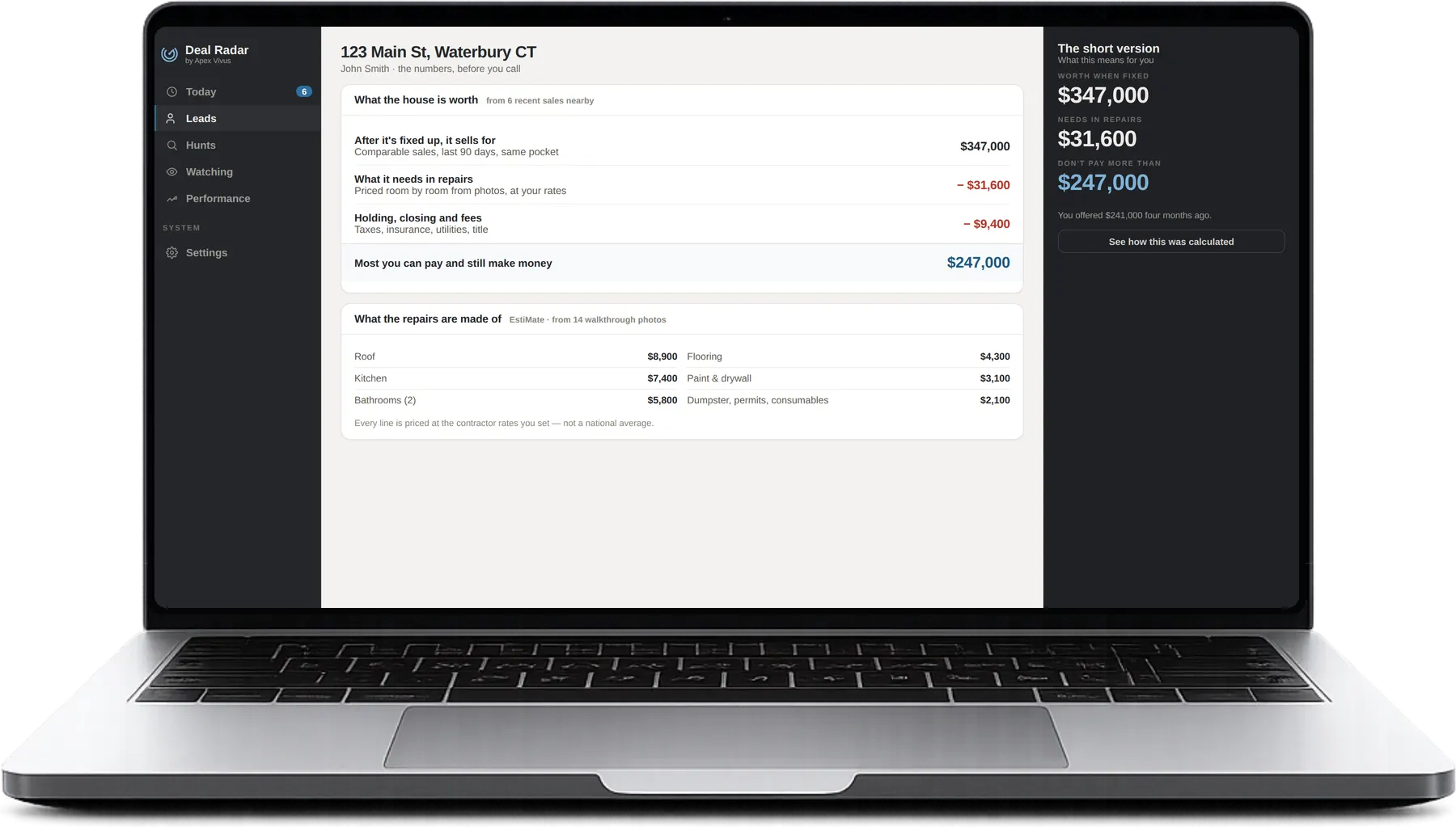
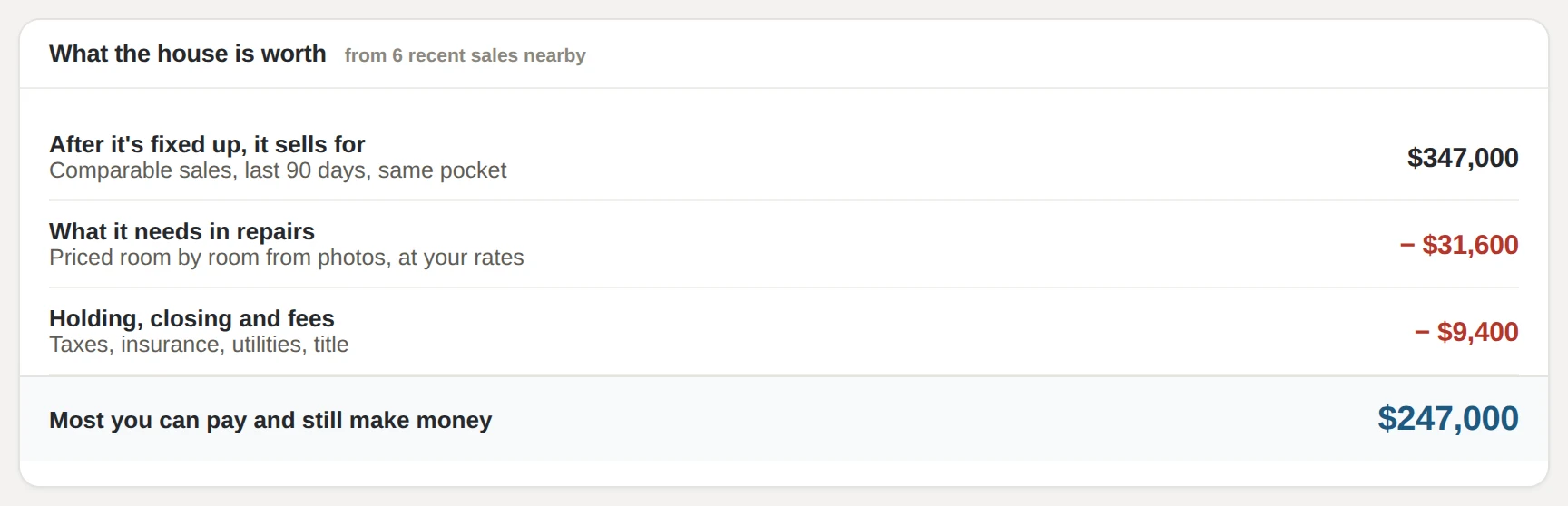
Send the seller a link, they photograph the rooms, and EstiMate prices the work line by line at your contractor rates — $31,600 here, not a national average. The house sells for $347,000 once it's fixed; take off repairs, holding and closing, and the most you can pay is $247,000. You offered $241,000 in March, so it still works.
Step 7 of 8 · the exit
And you know who buys it before you make the offer.
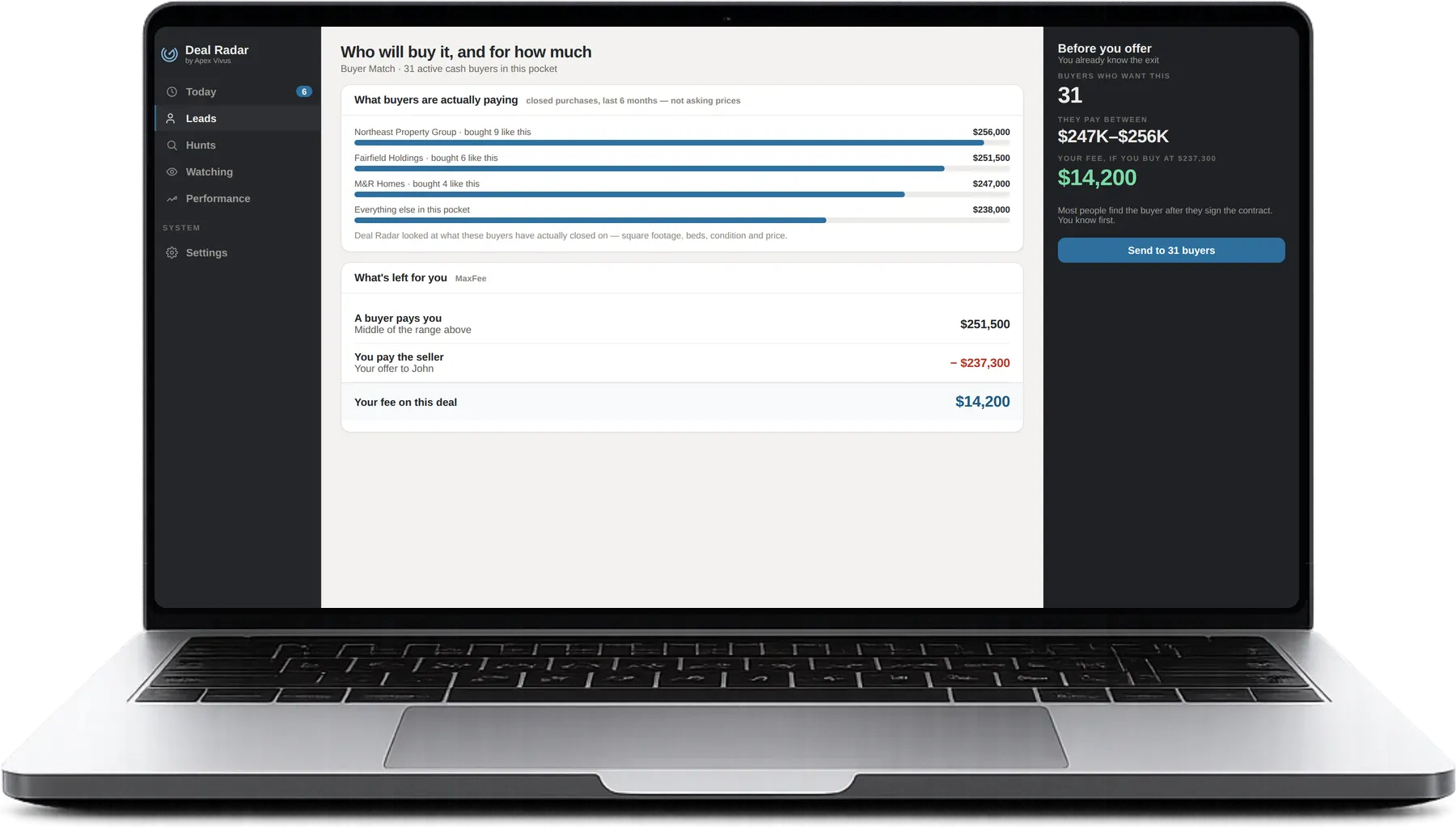
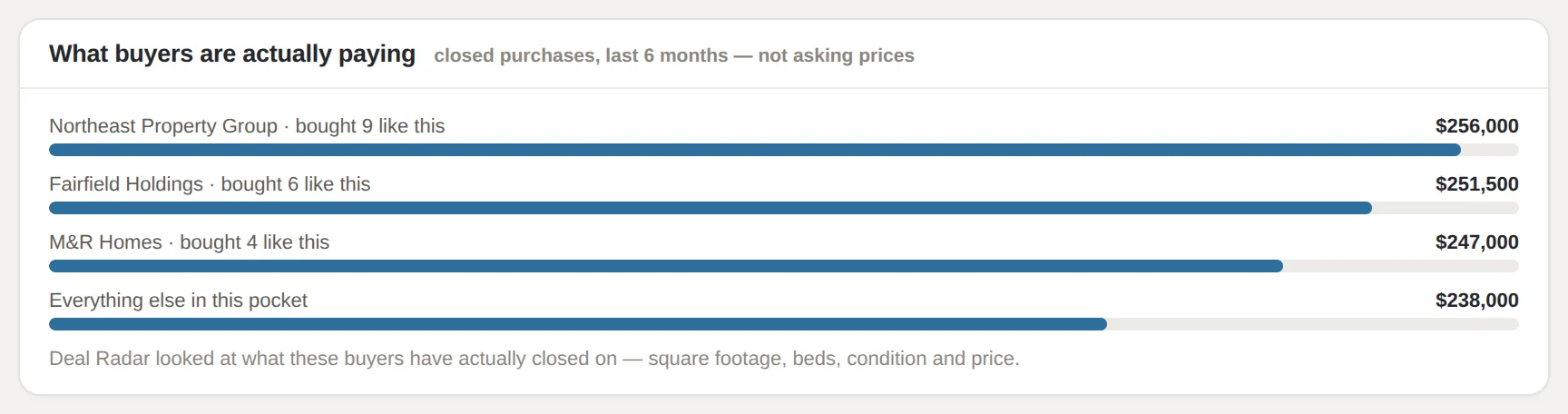
This isn't a list you uploaded. Deal Radar reads who is actually closing in this pocket — the companies buying houses like this one, how many they've taken down, and what they actually paid, from recorded transactions rather than from what anyone says they want. Thirty-one are active here, paying $247,000 to $256,000 for this profile. Buy at $237,300 and your fee is $14,200.
Step 8 of 8 · what it earned
Then it tells you what the whole thing was actually worth.
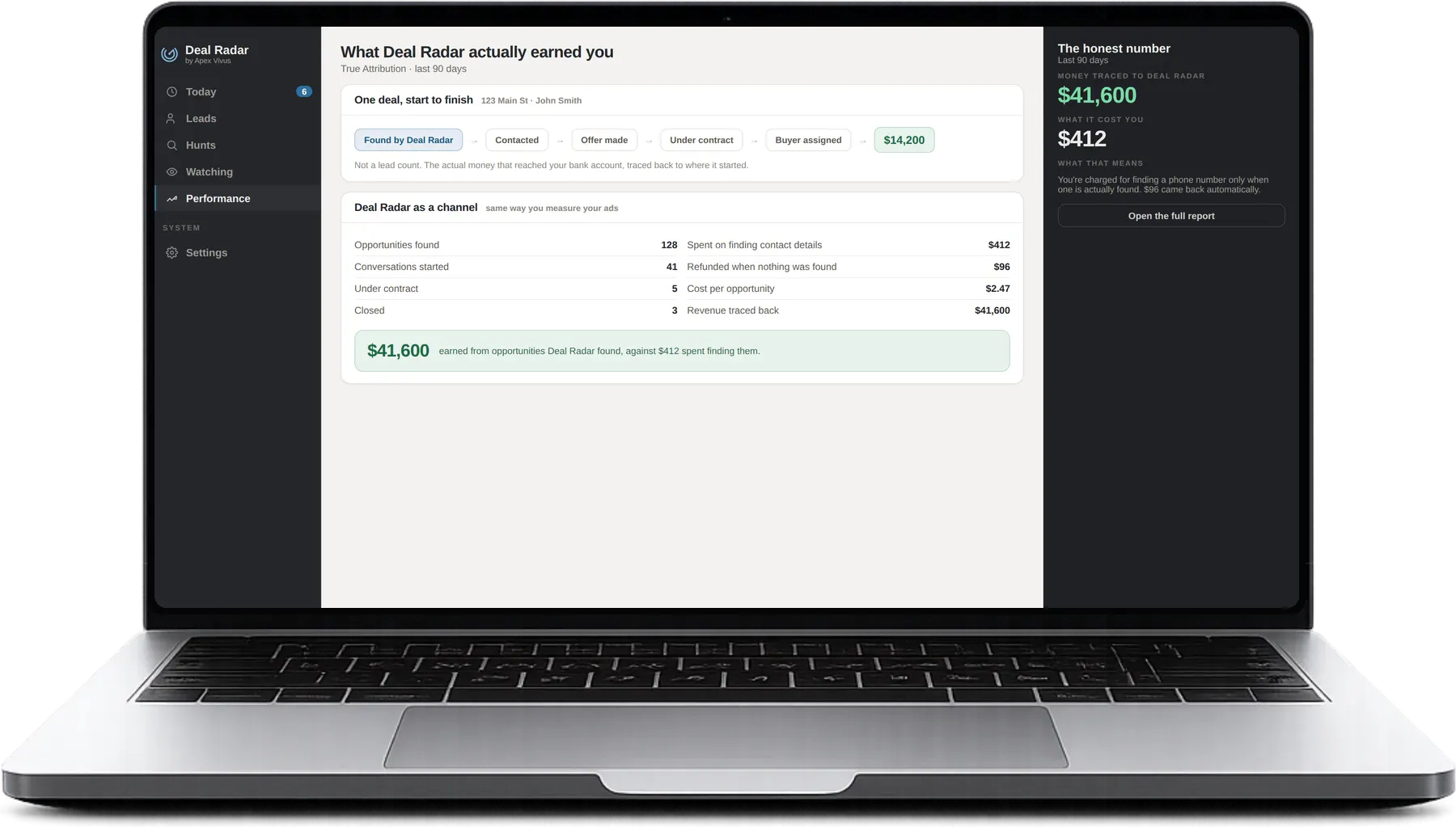
Found → contacted → offer → under contract → buyer assigned → $14,200. Over 90 days: 128 opportunities found, three closed, $41,600 traced back to Deal Radar against $412 spent finding phone numbers — $96 of which was refunded because nothing was found.
You set it up once. It did the rest.
Every screen above is the same deal, in order, from the night you switched it on to the day you got paid — and it runs again tonight, on every market you give it.
Deal Radar searches nationwide property records — deeds, mortgages, tax rolls, court filings, listing status and mail deliverability — for every property in the markets you pick, and reads the same records against the leads already in your CRM.
One record on its own means little. What matters is how a situation moves: a tax delinquency that becomes a lien, a lien that becomes a filing, a filing that becomes an auction date. Deal Radar keeps the dated history, weighs recent events heavier than old ones, and raises the score when independent signals stack up.
01Distress & deadlines
Public records — the events with a clock attached.
13 signals
Pre-foreclosure filed
Foreclosure
Auction scheduled
Auction date changed
Lis pendens recorded
Tax delinquency
Tax sale scheduled
Involuntary lien recorded
Utility lien recorded
HOA lien recorded
Judgment lien recorded
Code violation issued
Eviction filed by owner
02Ownership & property
Who owns it, what it’s worth, what the market is doing to it.
12 signals
Property vacant
Absentee owner
High equity
Likely free & clear
Estimated value declining
Recent deed transfer
Long-time owner (15y+)
Portfolio liquidation pattern
Listing expired/withdrawn without sale
List price reduced
Property newly listed
Property relisted
03Life events
The circumstances that put a house on the market.
5 signals
Inherited property
Probate case opened
Death-related transfer
Spousal death on title
Divorce filing
04Your CRM history
What already happened between you and this seller.
7 signals
Previous motivated-seller lead
Rejected a prior offer
Contact attempt logged
Scheduled an appointment
Missed an appointment
Seller expressed urgency
Seller expressed frustration/exhaustion
05Your website
Behaviour nobody else can see, because you own the site.
5 signals
Returned to your website
Submitted your form again
Clicked your offer link
Opened your email
Replied to your SMS
And nine that take an opportunity back off your list. A foreclosure cured, an auction cancelled, a tax debt paid, a lien released, the house sold or under contract, somebody moving back in — when the situation resolves, Deal Radar stops scoring it and clears it out.
Most tools only ever add. Deal Radar doesn't just tell you when to start paying attention — it tells you when to stop.
What makes Deal Radar different
Other platforms sell you tools. This one sells you capability.
Other platforms treat tools as separate things that need to be connected together for convenience. The REILink infrastructure is fundamentally different. The focus is not on the tools, features or the connections between them. It's capability and workflow.
Every tool on the system drastically influences what the next tool can do, and what the collective can do as a whole. A single addition exponentially increases the capability of the entire system — without adding infrastructure, or complexity for you.
To understand what that actually means, consider this:
The whole is greater than the sum of its parts.
$9.40 of ingredients becomes a $24 pie. Nothing was added except the way they came together. Anyone can buy the ingredients of a deal — property data, a CRM, a repair calculator, a buyers list. Owning them is the easy part. The value shows up in what they make together.
Add one ingredient. Everything else can do more.
This is the part that compounds. One egg makes one dish; add flour and water and you have five; add a few more and you have a bakery. Software behaves the same way when the parts share one system.
Deal Radar+Buyer Match
Deal Radar knows where opportunities may exist. Buyer Match knows what your buyers actually want.
Together they can find opportunities that fit the kinds of properties your buyers are already buying.
EstiMate+Deal Room+OfferAid+MaxFee
EstiMate works out what the property needs. Deal Room runs the economics. OfferAid works out what you can offer. MaxFee works out what's left for you.
One set of walkthrough photos changes the entire economics of the deal.
Deal Radar+CRM+Website
Deal Radar sees the property change. The CRM knows your history with the seller. The website knows he came back last night.
A property event becomes a seller opportunity with context.
Nobody sat down and built those three capabilities. They exist because the information was already in one place. That is what an infrastructure gives you that a collection of connected tools cannot.
The result isn't more tools. It's capability that none of the tools had on their own.
Any signal platformFinds prospects · watches records · reawakens dormant leads · looks up contactsAll four are table stakes. Deal Radar does them too.
Deal RadarEveryone can find the signal. Deal Radar already knows the seller, the property, the repairs, the buyers — and what closed.See the full feature-by-feature comparison
Getting started
Tonight it runs. Tomorrow you have a list.
There is no data to import, no list to buy and nothing to configure beyond your own markets.
1You pick your marketsCities, ZIP codes or counties — as many as you invest in. Takes a couple of minutes.
2You switch on what mattersChoose the situations you want Deal Radar to hunt for and set how many opportunities a day you want to see.
3It sweeps that nightThe first hunt runs the same evening, and it checks the leads already in your CRM too.
4Your first list, 6:30 AMScored, ranked, with the reason attached and contact details already looked up.
If you already use Apex Vivus, Deal Radar switches on inside the CRM you're working in — nothing moves. If you don't, it runs on its own and you work the list wherever you work today.
Outreach and consent. Deal Radar identifies opportunities and prepares your outreach. It never contacts property owners on your behalf without your approval, and owners never receive automated messages from Deal Radar itself. All outreach is initiated by you, and you are responsible for complying with TCPA, DNC and applicable state and local communication laws.
Estimates. Opportunity scores, preliminary values, repair estimates and maximum-offer calculations are analytical estimates drawn from public records, comparable sales and photo analysis. They are not appraisals and they are not guarantees of value, condition or outcome. Verify independently before making an offer.
Questions people ask
Before you ask us, here are the honest answers.
How is this different from buying a list?
A list is a snapshot of everyone who matched a filter on the day you bought it, and it's the same list the next person buys. Deal Radar doesn't hand you a list — it watches your markets every night, tracks how each situation changes over time, and surfaces a handful of owners when something moves. It also watches the leads you already own, which no list vendor can do.
Do I need Apex Vivus to use it?
No. Deal Radar runs on its own and you work the opportunities wherever you work today. Connected to Apex Vivus it can see more — your seller history, your website, your repair estimates, your buyers — so the same opportunity arrives with more context. Both are real products; the second is simply better informed.
Where does the data come from?
County and public records, deed and mortgage filings, tax and lien records, court filings, listing status, and mail-deliverability and occupancy data — plus, when connected to Apex Vivus, your CRM history and website activity. Contact details are looked up per owner.
Does it contact sellers for me?
It drafts the message, written to the situation it found, and schedules the follow-ups. Nothing goes out until you approve it. Property owners never receive automated messages from Deal Radar on your behalf without your say-so, and you remain responsible for complying with TCPA, DNC and your state's communication rules.
What does finding a phone number cost?
You're charged per owner it looks up, and only when something is actually found. An empty result is refunded automatically — you'll see both the charge and the refund on the record.
Will it bury me in alerts?
The opposite. You set a daily limit — ten is typical. Everything else keeps being watched and re-scored, and surfaces only if it changes enough to matter. Old signals lose weight over time, and a signal that resolves stops counting entirely.
Can I cancel?
Month to month, no contract. Your data is yours — the opportunities, the records and the history export with you.
Choose how you want to use it
Powerful on its own. More powerful when it knows your whole business.
Use Deal Radar with the system you already have, or connect it to Apex Vivus and give it access to the rest of the deal lifecycle. The choice is yours.
Standalone
Deal Radar
For investors who already have a CRM or operating system and want Deal Radar to actively hunt and monitor opportunities.
$850/month
Hunts your markets every night for owners in the situations you chose
Watches the leads already in your CRM and tells you when one changes
Brings back leads that went quiet months ago
Finds the owner's phone number and email — charged only when it finds one
Scores every opportunity out of 100, and shows which events moved it
Drops opportunities that resolve — a cured foreclosure stops taking up space
Runs first-pass numbers before you call
Hands you a short, ranked worklist each morning with the reason attached
Tracks what it produced — leads, contracts, closings, cost
Give Deal Radar access to the seller, website, property, repairs, deal economics, buyers and attribution inside Apex Vivus.
$997/month
Everything in Deal Radar, plus Apex Vivus Deal Intelligence:
Your whole history with that seller — calls, offers, what they said
What they do on your website, including coming back months later
Repairs priced room by room from walkthrough photos, at your rates
What you can pay, worked out from the real numbers instead of a rule of thumb
What cash buyers in that pocket have actually been paying
What's left for you if you assign it
Every deal traced back to what produced it, down to the check
Scored against your costs and returns, not a generic motivation score
One system — your website, CRM, forms and deal analysis included
+$147 a monthFor the price of a single skip-trace batch, every opportunity arrives with your seller history, the repair scope, the buyers and the fee already worked out.
Deal Radar finds the opportunity. Apex Vivus understands the entire deal.
One assignment can cover well over a year of Deal Radar.The deal in the walkthrough above returns $14,200. At $850 a month, one assignment like that covers more than 16 months of Deal Radar.
Deal Radar
Stop waiting for the next opportunity to find you.
Tell Deal Radar where you invest and what you're looking for. It will hunt the market, monitor what changes, and bring the opportunities worth your attention into view. And when you connect it to Apex Vivus, the opportunity doesn't stop at the signal. The rest of the deal is already there.